MEMETHICS
RÉVØLUTT
The guillotine haunts the French collective imagination — a radical social pendulum swing directed against elites and their abuses. Yet the French Revolution and the exercise of this form of social justice prove far more complex than the postcard image that remains.
First, because the narrative of that period is precisely that: a narrative — and every narrative constructs the reality it claims to describe. Second, because the guillotine, initially a symbol of popular uprising, became one of state violence, remaining in use as an instrument of capital punishment until its abolition in 1981.
Today, this form of violence has become illegitimate — not because corruption, ineptitude, or the abuses of elites have disappeared, or ceased to provoke outrage and revolt — but because the violent impulse itself has lost its place in so-called civilised societies, and perhaps even its object.
This obscure object of desire, the guillotine, persists as a fantasy of sovereign judgment, repair, and warning addressed to those in power. It embodies the transformation of social violent impulse into a methodical, pragmatic, and rational apparatus of eradication — a “final solution” whose administrative efficiency and surgical elegance emerged from the troubled imagination of Dr. Guillotin.
Adopting the familiar guise of an IKEA advertisement, RÉVØLUTT invites the viewer to assemble their own guillotine — a “direct democracy tool” delivered as a flat-pack kit — thus bringing back into consciousness a symbol repressed within the collective unconscious, democratized and made accessible to all.
The apparent humor of the device barely conceals the discomfort born from the collision between horror and the familiar.
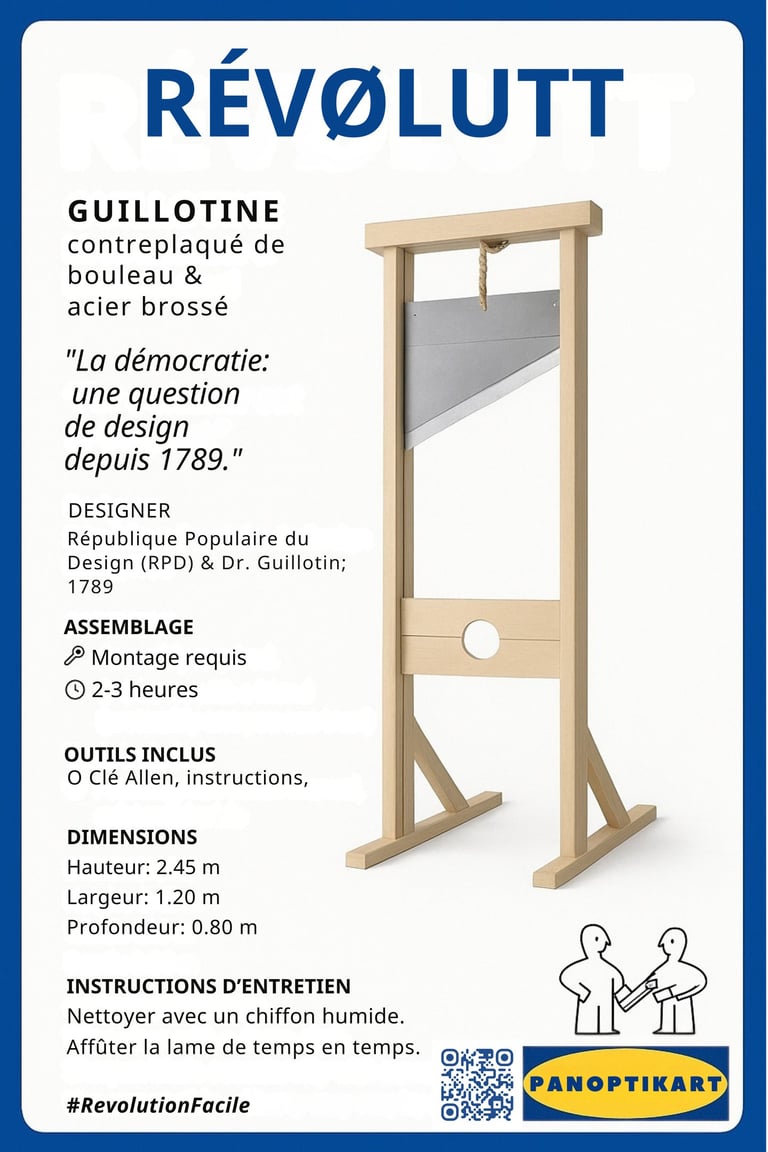

By détourning the codes of domestic comfort and Scandinavian conviviality, JC Trentinella exposes a disturbing dissonance between harmlessness and radicality, banality and terror. The guillotine — a symbol of unspeakable violence rendered illegitimate and repressed beneath the surface of collective consciousness — resurfaces here as a design object: an avatar of a capitalism that absorbs, banalizes, and neutralizes even the very idea of revolt.
Both meme and mirror, RÉVØLUTT is intended to circulate virally within digital culture, exposing our complicity in the commodification of anger. Its dissemination is not an incitement to violence, but a reflection on the fragility of the social contract — on the growing discord between the people and those who claim to represent them — a fragility whose very viral spread becomes its expression.
By transforming the guillotine into a consumer product to be assembled by the user, the work reveals the absurdity of rebellion turned into merchandise and the tragic irony of an era in which democracy, protest, and indignation have become mere content.
It is within this tension that the work’s power resides: RÉVØLUTT amuses through the familiarity of its language, then destabilizes through its message. It hijacks the mechanisms of viral culture against themselves, transforming the meme — a medium of superficiality — into a philosophical object.
RÉVØLUTT is not a parody, but a diagnosis. The work illuminates the contemporary impossibility of genuine revolt within a system that assimilates even its own critique. It reflects our complicity: our desire for a revolutionary thrill, carefully packaged within consumerist comfort.
At once invocation and conjuration, RÉVØLUTT evokes the spectre of revolt and the systemic violence of the state embodied by the guillotine. Repressed yet familiar, the guillotine reappears as a symptom — that of the unfinished mourning of the political body. Faced with the return of the repressed, the work explores the traumatic memory of a society built on rupture and bloodshed.
For the guillotine — or any other symbol of violence — cannot transform society for the better. The roots of social harm lie neither in the absence of punishment nor in the lack of fear, but elsewhere: in our relationships to power, desire, and otherness. The French Revolution, for all its fury and idealism, did not give birth to a virtuous society; it merely replayed, in different forms, the domination it claimed to abolish
To glorify change through violence is to regress toward instinct. Is it necessary? Beneficial? Inevitable?
True social transformation arises from lucidity — the kind that refuses to look away — from responsibility, and from collective maturity.
An adult society does not venerate violence; it does not sanctify fear, blood, or the thrill of overthrow. It learns to confront its own shadows, while refusing to submit to them.
And yet one uncomfortable, necessary question remains: what societal advances have not emerged through struggle — and at times, through violence?
GRINDÄR, 2025 (ENG)
Digital concept, print, meme-edition
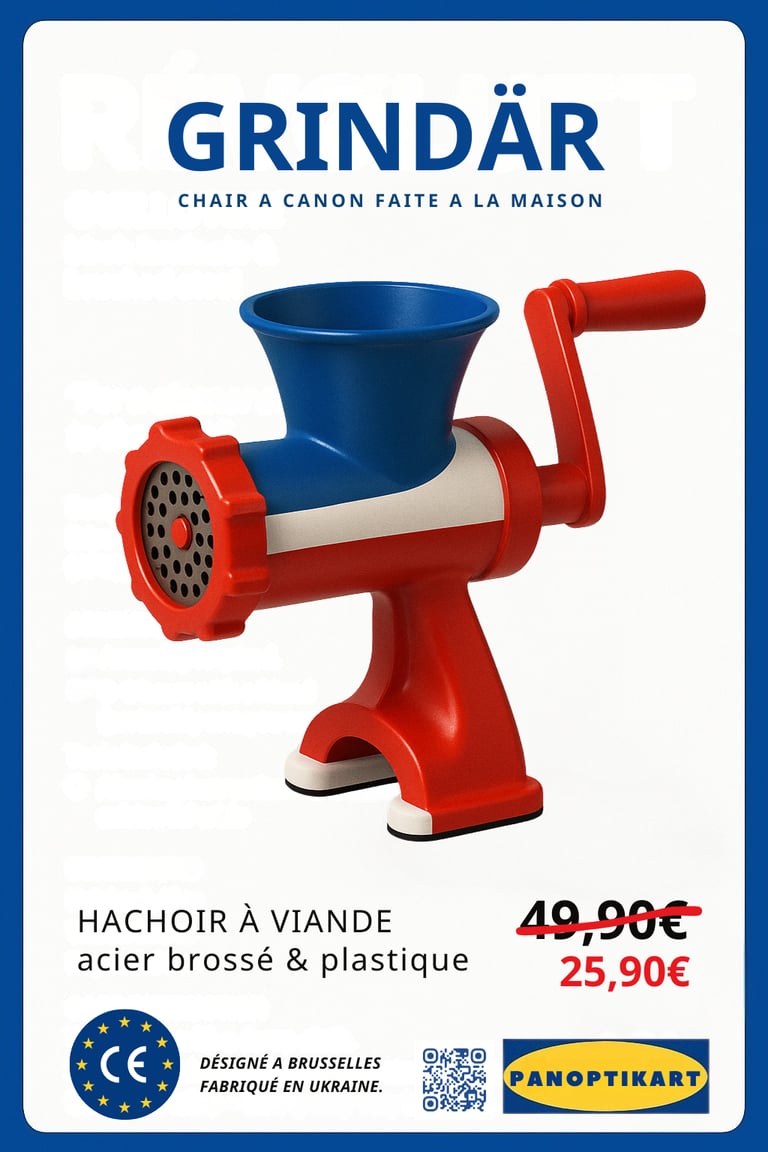
GRINDÄR repurposes a domestic appliance to expose the violence embedded in contemporary political discourse. Beneath the familiar surface of Scandinavian design, the meat grinder becomes a metaphor: a youth called upon to be sacrificed, turned into raw material for interests far beyond its control.
By borrowing the language of advertising — national colours, functional slogans, neutral ergonomics — the work reveals the normalisation of collective sacrifice: what should nourish a family becomes a device for producing cannon fodder destined to feed the war.
“Cannon fodder, made at home. Designed in Brussels. Manufactured in Ukraine.”
This fictional punchline lays bare a system where decisions are made at the centre while lives are shattered at the periphery.
GRINDÄR interrogates this strange normalisation of violence within European nations, where the rhetoric of duty barely conceals the industrial and technocratic logic in which bodies become mere adjustment variables inside the vast geopolitical machine.
But behind this rhetoric may lie something darker, older: a ritual logic of sacrifice offered to the invisible powers that govern our world and its economy. As if youth were the raw material of a system that periodically demands its tribute of lives to sustain itself.